



A little about the Kansai dialect. First, here's how to say "Kansai dialect" in Japanese:
関西弁
kansai ben
Today, we will take a look at an interesting aspect of the Japanese language, dialects. For a very long time, people in Japan were very limited in movement. As a result, individual areas developed distinct dialects. Today, most prefectures have their own dialect. Tokyo’s dialect is considered standard Japanese, but let's focus on the dialect of Osaka, Kyoto, and the surrounding area.
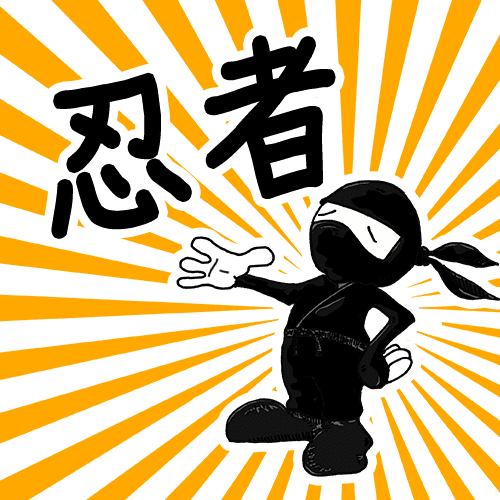
MOOD SETTING: You are brushing up on your kansai ben with a nice obaasan outside an udon shop when suddenly a ninja jumps out and says, "Goodo Morningu!"
NOTE: 弁 ben means dialect in Japanese. So the dialect of the Kansai area (Osaka, Kyoto…) is "KANSAI BEN." The dialects of other areas are called by the name of the area (or, usually, the prefecture name) and "ben." For example, the dialect of Fukui prefecture is "FUKUI BEN." For the kanji-lovers: This 「弁」is the same as in 弁当 (bentou; lunch box) and 弁護士 bengoshi (lawyer) – but, sadly, it is not related to 便所 benjo (toilet)
Let's get started.
1. GREETINGS [ あいさつ ]
毎度おおきに
maido ookini
Thank you (used instead of ARIGATOU)
毎度
maido
every time
This is often shortened to ookini also
儲かりまっか
moukarimakka ?
How are you? [lit. “Are you bringing in a profit?”]
This comes from the word moukaru [ 儲かる ] (to bring a profit)
The “standard” form would be “MOUKARIMASU KA?”
USAGE: mostly Osaka
ぼちぼちでんなぁ
bochi bochi denna – I’m fine (lit. So-so, you know)
BOCHI BOCHI – so-so, little by little
DENNAa – a contraction of DESU NA/NE
USAGE: mostly Osaka
おいでやす
oideyasu
Welcome! (used instead of IRASHAIMASE)
This has a softer feel than the cattle-call, “IRASHAI!!!”
USAGE: only Kyoto (maybe)
2. FUN STUFF
さぶいぼ
sabu ibo – goose bumps (when cold or scared)
sabu is from samui (cold)
ibo means ‘a wart’
USAGE: KANSAI
あかん
akan
instead of ‘DAME’ which means – no good, don’t do that, bad, must not…
USAGE: KANSAI
おもろい
omoroi – fun; interesting
From omoshiroi (interesting)
Stick a "na" at the end for a more emotional sound — "OMOROI NA!" (Man, that’s cool!)
USAGE: KANSAI
おかん
okan
mother
USAGE: Osaka
おとん
oton
father
USAGE: Osaka
どない
donai
How
STANDARD JAPANESE: DOU
や
ya
abrupt form of desu or the “to be” verb
STANDARD JAPANESE: DA