

English has one word for all of this: “only”. “I only have a thousand yen” can be a plain fact or a complaint, and the listener works out which from your face. Japanese does not leave it to your face. It has four words for “only”, and each one says something different about how you feel about the limit.
Every example sentence has audio, and its English is blurred on purpose. Read the Japanese first, then tap the blur to check yourself.
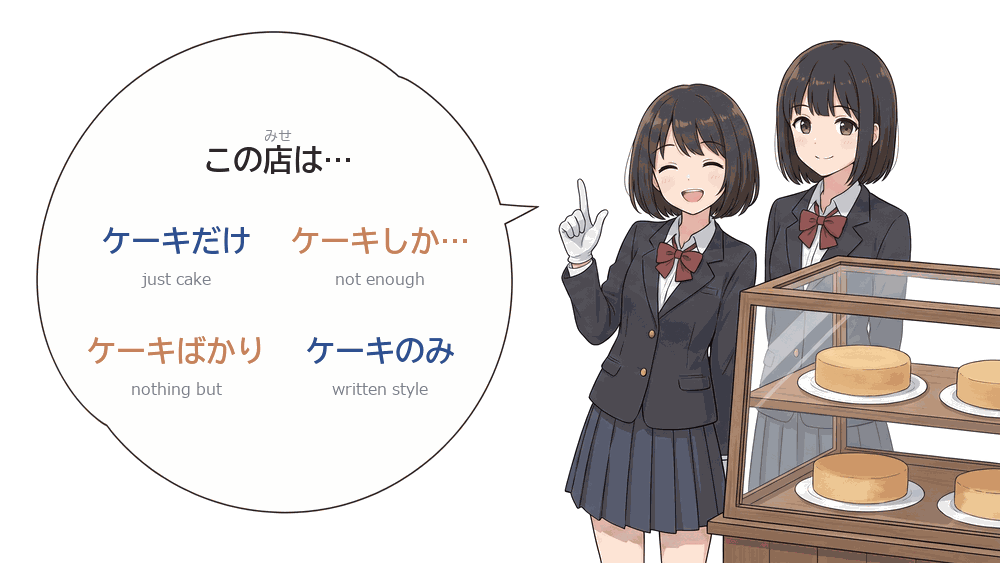
Here is the whole lesson in one sentence with four endings. You are describing a bakery that has nothing but cake:
この店はケーキだけ売っています ・ ケーキしか売っていません ・ ケーキばかり売っています ・ ケーキのみ販売していますThis shop sells only cake. This shop sells nothing but cake, and you wish it sold more. This shop sells nothing but cake, cake and more cake. This shop sells cake only, in the wording of a sign. Same shop, same cakes, four different attitudes to the limit.
Why These Four Get Confused
Because English does not make you choose. “He ate only cake” is true whether you are reporting a fact, grumbling about his diet or admiring his focus. Japanese puts the tone in the word.
だけ is the plain limit, with no feeling attached. しか is the limit with a sigh, “this much and it’s not enough”, and it must always be followed by ない. ばかり is “nothing but”, and it usually comes with a raised eyebrow. のみ is the written word: the same meaning as だけ, dressed for a sign or a notice.
Before you choose, ask: how do I feel about the limit? Neutral is だけ. Not enough is しか. Too much is ばかり. And if it is going on a sign, it is のみ.
The Four at a Glance
| Form | The feeling | Goes with | Closest English | Example |
|---|---|---|---|---|
| だけ | Neutral | A positive or a negative sentence | only, just | 水だけ飲みました。I drank only water. |
| しか〜ない | Not enough | Always a negative | only, nothing but, no more than | 水しか飲みませんでした。I had nothing but water. |
| ばかり | Too much | A positive sentence, usually | nothing but, all the time | 水ばかり飲んでいます。All I drink is water. |
| のみ | Formal, written | A positive sentence | only | 水のみ提供します。Water only is provided. |
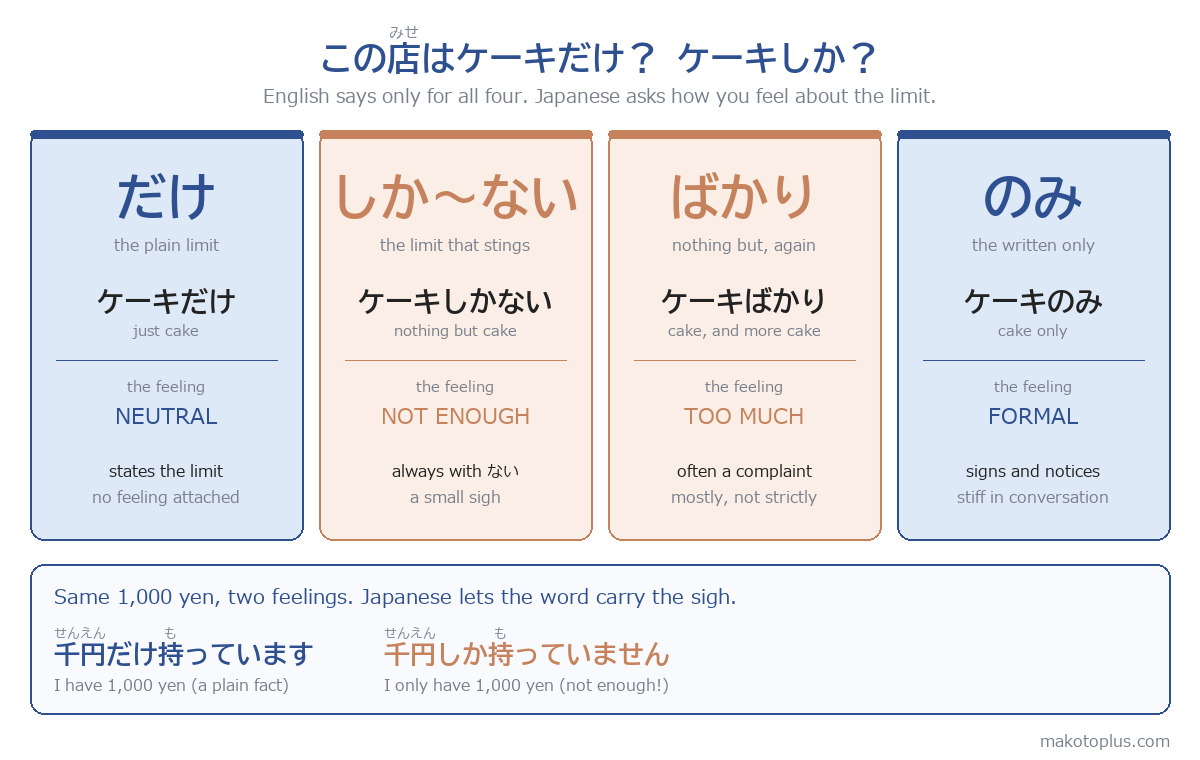
The whole lesson on one card.
だけThe Plain Limit
だけ is “this much and no more”, and nothing about it is emotional. It goes after a noun, a verb in the dictionary form or an adjective, and it works in a positive or a negative sentence. A particle that carries meaning, like に, で or と, stays in front of it: 田中さんにだけ.
このことは田中さんにだけ話しました。
[A fact about who you told. The に stays: だけ usually replaces が and を, but a particle like に, で or と keeps its place and だけ follows it.]
見るだけです。買いません。
[A verb plus だけ means “only doing that”, and it is what you say to a shop assistant. 見るだけ is a set phrase worth keeping.]
しか〜ないThe Limit That Stings
しか never appears alone. It must be followed by a negative, and the negative is not a quirk, it is the meaning: “nothing besides this”. The English that matches it best is “only” with a sigh. Reach for it whenever the amount falls short of what you wanted.
千円しかありません。
[You can hear the wallet being checked. 千円だけあります (I have 1,000 yen) is a statement of fact; しか adds that it is not enough.]
このことは母にしか話していません。
[Compare 田中さんにだけ話しました above. だけ reports who you told; しか adds “and no one else, so keep it quiet.”]
もう時間がないから、やるしかありません。
[A verb plus しかない means “there is no choice but to…”. It is a pattern worth owning: やるしかない, 行くしかない, 待つしかない.]
ばかりNothing But
ばかり points at a lot of one thing, and it usually comes with a feeling: surprise, complaint, a shake of the head. It is not strictly exclusive the way だけ is. It also has other jobs that have nothing to do with “only”, and the commonest is た-form plus ばかり, meaning “just did”.
弟はお菓子ばかり食べています。
[A noun plus ばかり, and the particle を disappears. Said to a worried parent, this is a complaint; said with a laugh, it is a joke about his diet.]
弟は遊んでばかりいます。
[て-form plus ばかり plus いる means “doing nothing but”. It must be the て-form, and it is often followed by a sigh.]
昼ごはんを食べたばかりです。
[Nothing to do with “only”: た-form plus ばかり means “just did”. It is how you decline a second lunch.]
のみThe Written Only
のみ means exactly what だけ means, in a different register. It is what you see on signs, in notices, on menus and in the news, and it is stiff in conversation. Learners meet it long before they can say it, so reading it is the skill that matters.
お支払いは現金のみです。
[The cash-only sign at a small shop, as a sentence. 現金のみ on its own is the version on the sign.]
日本のみならず、世界中で人気があります。
[のみならず is “not only”, the written form of だけでなく. It is how news writers say it.]
Using Them Together
休みは日曜日しかなくて、毎日仕事ばかりです。
[Both feelings at once: しか for the too-little of days off, ばかり for the too-much of work. A person who says this is not happy, and the two words say so twice.]
Three Sentences Worth Getting Wrong Once
1. しか with a positive
✗ 財布には百円しかあります。 しか is built to be followed by a negative. This sounds unfinished to a Japanese ear.
財布には百円しかありません。 (I only have 100 yen in my wallet.) If you want to keep the verb positive, switch the word: 百円だけあります is fine, with the sigh gone.
2. ばかり for “only one”
✗ 兄弟は一人ばかりいます。 ばかり after a number means “about”, so this sounds like “I have about one sibling”. English “only one” invites the mistake.
兄弟は一人しかいません。 (I have only one brother or sister.) Use しか for a small number you wish were larger, or だけ for a plain count.
3. The dictionary form before ばかり
✗ 弟はお菓子を食べるばかりいます。 “Nothing but eating” needs the て-form. The dictionary form plus ばかり means “all that’s left is to eat”.
弟はお菓子を食べてばかりいます。 (My little brother does nothing but eat sweets.) The easiest fix is to move the ばかり to the noun: お菓子ばかり食べています.
Quick Self-Check
Pick the word. Answers below.
- (レストランの看板)現金__ (しか ・ のみ ・ ばかり ・ だけ)(A sign at a restaurant door) Cash only.
- 今月はお金が五千円__ありません。 (だけ ・ ばかり ・ のみ ・ しか)This month I have only 5,000 yen (and that’s not enough).
- 彼はいつも冗談__言っています。 (ばかり ・ しか ・ のみ ・ だけ)He’s forever joking around.
- 先週日本に来た__で、まだ何もわかりません。 (だけ ・ ばかり ・ しか ・ のみ)I only just arrived in Japan last week, so I still understand nothing.
Answers. 1. のみ, because a sign is written language. 2. しか, because the ありません is the partner しか is waiting for. 3. ばかり, because いつも and ばかり are the natural pair: a lot of one thing, and the speaker has noticed. 4. ばかり, because た-form plus ばかり means “just did”.
If you remember one thing, make it this: だけ states the limit, しか feels it, ばかり complains about it, and のみ puts it on a sign. English says “only” for all four, so before you pick, ask the question English never makes you ask: how do I feel about the limit?
Samurai and Shogun Makoto+ members get the full deep dive on だけ, しか, ばかり and のみ:
- Every form with five to seven examples instead of two or three, plus the four other jobs ばかり does, what happens to the particles, and how to say “not only… but also”
- Audio on all 32 example sentences
- An interactive quiz that tells you why each answer is right or wrong, including the tempting ones
- A printable two-page reference and practice sheet to download
- A new grammar deep dive every week
Not yet a member? Let’s fix that
Already a Samurai or Shogun member? Click here for the in-depth lesson and the download.