
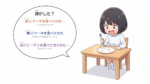


Japanese can take one verb and turn it three ways. 食べる (to eat) becomes 食べられる (to be eaten) when it is done to you, 食べさせる (to make or let someone eat) when you make it happen, and 食べさせられる (to be made to eat) when someone else makes you do it. Textbooks call them the passive, the causative and the causative-passive, and learners mix them up because they are built from the same pieces. One question sorts them: who did it, who made it happen, and who had no choice?
Every example sentence has audio, and its English is blurred on purpose. Read the Japanese first, then tap the blur to check yourself.
Here is the whole lesson in one verb, three ways:
弟にケーキを食べられた ・ 弟にケーキを食べさせた ・ 母にピーマンを食べさせられたMy little brother ate my cake. I let my little brother eat the cake. My mom made me eat green peppers. In the first, the brother did it and it happened to you. In the second, the brother still did the eating, but you made it happen. In the third, you did the eating, and Mom made you.
Why These Three Get Confused
Because they are made of the same parts, and they stack: させる plus られる is させられる. Each one also leans on に, and に marks a different person in each. In the passive it is whoever did it to you. In the causative it is whoever you made (or let) do it. In the “made to” form it is whoever made you. The verb never changes. What moves is who is in charge.
Before you choose, ask: who did it, who made it happen, and who had no choice? If someone else did it and it landed on you, it is られる. If you made it happen, or let it, it is させる. If someone else made you do it, it is させられる. In all three, に marks the other person.
The Three at a Glance
| Which form | What it says | Who is in charge | Closest English | Example |
|---|---|---|---|---|
| られる | It was done to me. Someone else acted, and it landed on the subject | The に person, who did it | was praised, got rained on | 先生にほめられました。I was praised by my teacher. |
| させる | I made it happen, or I let it happen | The subject. に or を marks who did the doing | make, let, have someone do | 母は弟に野菜を食べさせた。Mom made my little brother eat his vegetables. |
| させられる | I had no choice. Someone made me do it | The に person, who made me | was made to | 先輩にお酒を飲まされた。A senior coworker made me drink. |

The whole lesson on one card.
One Verb, Three Sentences
弟にケーキを食べられた。
[The brother did the eating and sits behind に. The subject is you, the one it happened to.]
弟にケーキを食べさせた。
[He still did the eating, but now you made it happen. Out of context it could also be “I made him eat it”; the situation decides.]
母にピーマンを食べさせられた。
[Now you did the eating, and Mom made you. させられる is the form for having no choice.]
られるIt Was Done to Me
The passive makes the person something happened to into the subject and moves whoever did it behind に. With a る-verb, swap る for られる: 食べられる (to be eaten). With an う-verb, put れる where the ない of the ない-form was: 書かれる (to be written), 言われる (to be told). する becomes される and 来る becomes 来られる.
駅で財布を盗まれました。
[The wallet stays the object with を, and the subject is you, though you are never mentioned. Japanese makes the owner the one it happened to.]
Japanese can also make a passive from a verb with no object at all, which English cannot. Then the sentence says that something happened, and it happened to you, usually to your cost. That is why so many Japanese passives sound like complaints.
帰り道で雨に降られた。
[降る (to fall) has no object, so English has no passive for it. Japanese does: the rain fell, and it fell on you.]
させるI Made It Happen (or Let It)
The causative puts you in charge, and the person who actually did the action moves behind に (or を, with a verb that has no object). “Make” or “let” is left to the situation. A る-verb takes させる: 食べさせる (to make or let eat). An う-verb puts せる where ない was: 書かせる (to make or let write). する becomes させる and 来る becomes 来させる.
母は弟に野菜を食べさせた。
[Mom is in charge, and に marks the brother, the one who did the eating.]
少し考えさせてください。
[〜させてください asks permission: “let me”. The polite way to buy yourself time.]
させられるI Had No Choice
Put the causative into the passive and you get the form for being made to do something: 食べさせられる (to be made to eat). You did the action, someone else made you, and they sit behind に. With an う-verb there is a shorter form you will hear far more in speech: 飲まされる (to be made to drink), 待たされる (to be kept waiting). It does not work for verbs ending in す: 話させられる (to be made to talk).
先輩にお酒を飲まされた。
[The short form of 飲ませられた. 先輩に marks who made you, and you would rather not have.]
病院で二時間も待たされた。
[待たされる is the everyday “kept waiting”. も after 二時間 means “a whole two hours”, so the complaint is built in.]
Using Them Together
弟に部屋を散らかされて、母に片付けさせられた。
[散らかされて is the brother’s mess landing on you; 片付けさせられた is Mom making you deal with it. Two things done to you in one breath.]
Three Sentences Worth Getting Wrong Once
1. Making your foot the subject
✗ 電車で私の足が踏まれた。 English says “my foot was stepped on”, but in Japanese the passive happens to the person, not the body part.
電車で足を踏まれた。 (Someone stepped on my foot on the train.) You are the subject, left unsaid, and the foot stays the object with を.
2. させた where you meant させられた
✗ 子どものころ、母に毎日勉強させた。 This says you made your mom study every day.
子どものころ、母に毎日勉強させられた。 (When I was a kid, my mom made me study every day.) You were the one with no choice.
3. 〜てください where you meant 〜させてください
✗ 今日は早く帰ってください。 Said to your boss, this sends your boss home early.
今日は早く帰らせてください。 (Please let me go home early today.) Asking permission for yourself is 〜させてください.
Quick Self-Check
Pick the form. Answers below.
- 帰り道で雨に___。 (降った ・ 降らせた ・ 降られた ・ 降らせられた)I got caught in the rain on the way home.
- 子どものころ、父に毎朝五キロ___。 (走らせた ・ 走られた ・ 走った ・ 走らされた)When I was a kid, my father made me run five kilometers every morning.
- すみません、この仕事、私に___。 (やってください ・ やらせてください ・ やられてください ・ やらされてください)Excuse me, please let me do this job.
- 友だちに一時間も___、もう帰りたくなった。 (待った ・ 待たれて ・ 待たせて ・ 待たされて)My friend kept me waiting a whole hour, and I felt like going home.
Answers. 1. 降られた, the passive English doesn’t have: the rain fell on you. 2. 走らされた, because your father made you (走らせられた is also correct). 3. やらせてください, which asks permission for yourself. 4. 待たされて, because your friend made you wait; 待たせて would mean you kept your friend waiting.
If you remember one thing, make it this: られる is done to you, させる is you making it happen, and させられる is someone else making you. Keep the verb, and move the person in charge.
Want the passive on its own first? See our introduction to the passive form.

Samurai and Shogun Makoto+ members get the full deep dive on られる, させる and させられる:
- Five examples for each form instead of one or two, plus a full table of how to build all three from every kind of verb, and the passive that also means “can”
- Audio on all 25 example sentences
- An interactive quiz that tells you why each answer is right or wrong, including the tempting ones
- A printable two-page reference and practice sheet to download
- A new grammar deep dive every week
Not yet a member? Let’s fix that
Already a Samurai or Shogun member? Click here for the in-depth lesson and the download.