
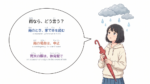


Japanese has three everyday ways to say “when”, and a dictionary will give you “when” for all of them. とき (when, the time that) is the one you already know. 場合 (in case, if it happens) turns up in instructions and plans. 際 (on the occasion of) is on the sign by the train door and at the end of every polite email. Learners swap them freely, and a native speaker hears the difference at once. One question sorts them: is it a moment, a contingency, or an occasion on a sign?
Every example sentence has audio, and its English is blurred on purpose. Read the Japanese first, then tap the blur to check yourself.
Here is the whole lesson in one kind of weather, three ways:
雨のとき、家で本を読みます ・ 雨の場合は、試合は中止です ・ 雨天の際は、体育館で行いますWhen it rains, I read at home. If it rains, the game will be canceled. In the event of rain, it will be held in the gym. The first is just a time: rainy days, and what you do on them. The second is a plan B for rain that may never come. The third is the same plan B, written on the notice board.
Why These Three Get Confused
Because they attach the same way and they all come out as “when” in English. 雨のとき says “at times when it rains”, with no plan and no formality. 雨の場合 says “in the case that it rains”, and quietly admits it might not. 雨天の際 says much the same as 場合, in the voice of an official notice.
Before you choose, ask: is it a moment, a contingency, or an occasion on a sign? A time, any time, in any register: とき. Something that may or may not happen, and what to do if it does: 場合. A formal occasion, in announcements, notices and polite business language: 際. When in doubt, とき is almost never wrong in conversation.
The Three at a Glance
| Which word | What it says | Where you meet it | Closest English | Example |
|---|---|---|---|---|
| とき | A moment: the time when something happens, past, present or habitual | Everywhere, every register | when, while, at the time | 子どものとき、よく川で泳ぎました。When I was a child, I often swam in the river. |
| 場合 | A contingency: if this happens, here is what to do. It may never happen | Instructions, rules, plans, explanations | in case of, if, in this case | 地震の場合は、机の下に入ってください。In case of an earthquake, get under your desk. |
| 際 | An occasion, said formally | Signs, announcements, business email, speeches | on the occasion of, when (formal) | お降りの際は、足元にご注意ください。Please watch your step when getting off. |

The whole lesson on one card.
ときA Moment
とき is the everyday “when”, for past events, habits, feelings and plans, in any register. A noun takes の (子どものとき), a な-adjective keeps な (暇なとき), and verbs and い-adjectives go straight in (寒いとき, 行ったとき).
子どものとき、よく川で泳ぎました。
[A stretch of your past is a time, so it takes とき. 場合 could never say this: being a child is not a contingency.]
The surprise for English speakers: the tense before とき does not follow the main sentence. It says whether that action had happened yet.
日本に行くとき、新しいカメラを買いました。
[行くとき: you had not got to Japan yet, so you bought it at home. Change it to 行ったとき and you bought it in Japan.]
場合A Contingency
場合 means “case”, and as “when” it means “in the case that”. It plans for something that may never happen, which is why it fills fire notices, card agreements and instructions. It attaches just like とき and usually takes は: 地震の場合は, 遅れる場合は. On its own it is also the word for “case”: この場合 (in this case).
地震の場合は、机の下に入ってください。
[The classic 場合. Nobody knows if an earthquake will come, and this tells you what to do if one does.]
遅れる場合は、必ず連絡してください。
[A rule for a possibility. Most people will not be late; this is for the ones who are.]
際An Occasion on a Sign
際 is the formal “when”: train announcements, notices, shop signs, business email. A noun takes の, often with polite お or ご (お降りの際, ご利用の際); a verb goes straight in with no の (出張した際). It is not for your own everyday feelings and habits.
お降りの際は、足元にご注意ください。
[You will hear this on nearly every train in Japan. お降り is the polite noun for getting off, so it takes の.]
日本にお越しの際は、ぜひご連絡ください。
[A polite invitation from a business email. With a friend you would say 日本に来るとき、連絡してね.]
Using Them Together
チケットをなくした場合は、ご入場の際に受付でお申し出ください。
[A notice at a concert hall. Losing your ticket might happen, so 場合. Coming in will happen, and the hall says it formally, so 際.]
Three Sentences Worth Getting Wrong Once
1. 場合 for something that really happened
✗ 昨日、駅に着いた場合、雨が降り出しました。 This sounds like a rule about a possibility, not something you are telling as a fact.
昨日、駅に着いたとき、雨が降り出しました。 (Yesterday, just as I got to the station, it started to rain.) One real event in the past is a moment, so とき.
2. 際 for a feeling
✗ 眠い際、コーヒーを飲みます。 It dresses up a sleepy afternoon as a formal occasion.
眠いとき、コーヒーを飲みます。 (When I’m sleepy, I drink coffee.) Feelings, states and habits take とき.
3. 出たとき where you meant 出るとき
✗ 家を出たとき、電気を消します。 出たとき means once you are already out the door, so this has you switching the lights off from the street.
家を出るとき、電気を消します。 (I turn off the lights when I leave the house.) It happens on your way out, so the verb stays in the dictionary form.
Quick Self-Check
Pick the word. Answers below.
- ___、よく祖母の家に遊びに行きました。 (子どもの場合 ・ 子どもの際 ・ 子どものとき ・ 子どもなら)When I was a child, I often went to play at my grandmother’s house.
- 日本へ___、空港で円に両替しました。 (行くとき ・ 行ったとき ・ 行く場合 ・ 行った際)Before I left for Japan, I changed money into yen at the airport.
- ___は、足元にご注意ください。 (降りるの際 ・ お降りの際 ・ 降りた場合 ・ 降りたとき)Please watch your step when getting off.
- 昨日、家に___、母から電話がありました。 (帰った場合 ・ 帰ったとき ・ 帰る場合 ・ 帰った際)Yesterday, just as I got home, my mom called.
Answers. 1. 子どものとき, because your childhood is a time, not a case or an occasion. 2. 行くとき, because you had not got to Japan yet; 行ったとき would put you at an airport in Japan. 3. お降りの際, the train announcement (a verb would take no の: 降りる際). 4. 帰ったとき, one real moment in the past; 場合 cannot be the “when” of that, and 際 is too formal for a call from Mom.
If you remember one thing, make it this: とき is a moment, 場合 is a plan B, and 際 is the notice board. In conversation, とき is almost never wrong.
Want them one at a time first? See our pages on とき for JLPT N5 and 場合 for JLPT N4.
Samurai and Shogun Makoto+ members get the full deep dive on とき, 場合 and 際:
- Five examples for each word instead of one or two, the stock 際 phrases from trains, shops and email, and what 場合 can never describe
- Audio on all 24 example sentences
- An interactive quiz that tells you why each answer is right or wrong, including the tempting ones
- A printable two-page reference and practice sheet to download
- A new grammar deep dive every week
Not yet a member? Let’s fix that
Already a Samurai or Shogun member? Click here for the in-depth lesson and the download.